PDMPFlux
Documentation for PDMPFlux.
PDMPFlux.PDMPStatePDMPFlux.RHMCPDMPFlux.SpeedUpZigZagPDMPFlux.StickyZigZagPDMPFlux.ZigZagPDMPFlux.ForwardECMCADPDMPFlux.RHMCADPDMPFlux.anim_traj_PDMPFlux.plot_U_contourPDMPFlux.samplePDMPFlux.sample_from_skeletonPDMPFlux.sample_from_skeletonPDMPFlux.sample_skeletonPDMPFlux.sample_skeletonPDMPFlux.sample_skeletonPDMPFlux.sample_skeleton_with_diagnostic
using PDMPFlux

function ∇U(x::AbstractVector)
    return x
end

dim = 10
sampler = ForwardECMC(dim, ∇U)

N_sk, N, xinit, vinit = 20_000, 5_000, zeros(dim), ones(dim)
samples = sample(sampler, N_sk, N, xinit, vinit, seed=2025)

jointplot(samples)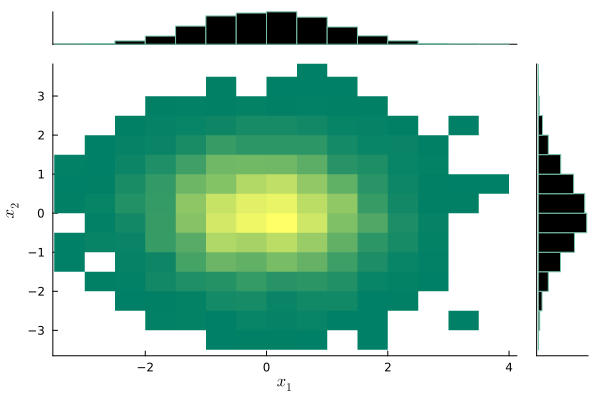
using PDMPFlux

function U_banana(x::AbstractVector)
  mean_x2 = (x[1]^2 - 1)
  return -(- x[1]^2 + -(x[2] - mean_x2)^2 - x[3]^2) / 2
end

dim = 3
sampler = ForwardECMCAD(dim, U_banana)

N_sk, xinit, vinit, T_horizon = 20_000, zeros(dim), ones(dim), 1000.0
output = sample_skeleton(sampler, T_horizon, xinit, vinit, seed=2025)

plot_traj(output, 50, plot_type="3D")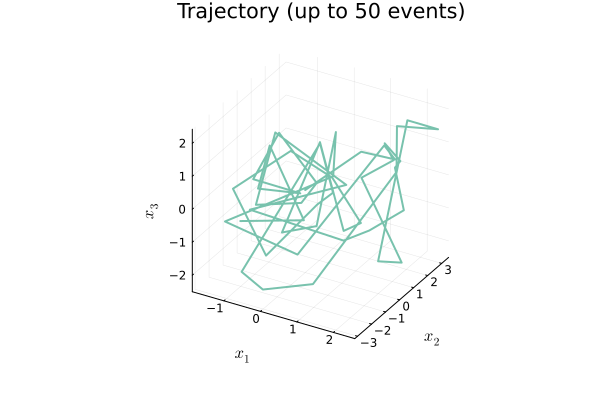
PDMPFlux.ForwardECMCAD — Method
ForwardECMCAD(dim, U; kwargs...)Create ForwardECMC sampler with automatic differentiation.
Arguments
dim::Int: Dimension of the state spaceU::Function: Potential function
Keywords
grid_size::Int=10: Number of grid points for upper boundtmax::Union{Float64, Int}=2.0: Maximum time horizonsigned_bound::Bool=true: Use signed bound strategyadaptive::Bool=true: Use adaptive time horizonAD_backend::String="ForwardDiff": Automatic differentiation backendran_p::Bool=true: Use random orthogonal refreshmix_p::Float64=0.5: Mixture probability for refreshment
Returns
ForwardECMC: Configured sampler instance
PDMPFlux.RHMCAD — Method
RHMCAD(dim::Int, U::Function; kwargs...)Convenience constructor that builds ∇U via the selected AD backend, like ZigZagAD etc.
PDMPFlux.anim_traj_ — Method
A buffer function under development
supports faded color animationPDMPFlux.plot_U_contour — Method
Create a contour plot of the potential function U (2D).
Arguments
U: potential function taking a 2D vectorx_range: range for the x-axis (default:range(-5, 5, length=100))y_range: range for the y-axis (default:range(-5, 5, length=100))levels: number of contour levels (default: 20)color: color palette (default::viridis)fill: whether to fill contours (default: true)show_grid: show grid (default: false)show_axis: show axis ticks/labels (default: false)show_title: show title (default: false)xlabel: x-axis label (default:L"x_1")ylabel: y-axis label (default:L"x_2")background: background (default::transparent)linewidth: contour line width (default: 1)filename: output filename to save (default:nothing)
PDMPFlux.sample — Method
sample(): draw samples from a `AbstractPDMP` sampler.

This is a thin wrapper that calls `sample_skeleton()` and then `sample_from_skeleton()`.

Args:
    N_sk (Int): Number of skeleton points to generate.
    N_samples (Int): Number of final samples to generate from the skeleton.
    xinit (Array{Float64, 1}): Initial position.
    vinit (Array{Float64, 1}): Initial velocity.
    seed (Int): Seed for random number generation.
    verbose (Bool, optional): Whether to print progress information. Defaults to true.

Returns:
Array{Float64, 2}: Array of samples generated from the PDMP model.PDMPFlux.sample_from_skeleton — Method
Sample along a skeleton and return a `Matrix{Float64}` whose rows store per-dimension time series.

Args:
    dt (Float64): The time step.
    output (PdmpOutput): The PDMP output containing the trajectory information.

Returns:
Array{Float64, 2}: The sampled points from the PDMP trajectory skeleton.PDMPFlux.sample_from_skeleton — Method
Sample along a skeleton and return a Matrix{Float64} whose rows store per-dimension time series.
Args: N (Int): The number of samples to generate. output (PdmpOutput): The PDMP output containing the trajectory information.
Returns: Array{Float64, 2}: The sampled points from the PDMP trajectory skeleton.
PDMPFlux.sample_skeleton — Method
sample_skeleton(sampler::AbstractPDMP, T::Float64, xinit, vinit; seed, verbose, init_capacity)Time-horizon variant: advance the PDMP up to time T (instead of generating n_sk events) and return the skeleton.
- Since the number of events is not known a priori,
PDMPHistoryis allocated withinit_capacityand grown by doubling as needed (with copying). - The return value is forced to satisfy
t[end] == Tby adding one final point att=Tvia deterministic flow (becausesample_from_skeletonusest[end]as the time scale).
PDMPFlux.sample_skeleton — Method
failsafe dispatch of sample_skeleton(), admitting scalar initial values, used mainly for 1d case.PDMPFlux.sample_skeleton — Method
sample_skeleton(): generate a PDMP skeleton (event times/states) from a PDMP sampler.

Parameters:
- n_sk (Int): The number of skeleton samples to generate.
- xinit (Array{Float64, 1}): The initial position of the particles.
- vinit (Array{Float64, 1}): The initial velocity of the particles.
- seed (Int): The seed value for random number generation.
- verbose (Bool): Whether to display progress bar during sampling. Default is true.

Returns:
- output: The output state of the sampling process.PDMPFlux.sample_skeleton_with_diagnostic — Method
sample_skeleton_with_diagnostic(): generate a PDMP skeleton (event times/states) from a PDMP sampler with diagnostic information.

Parameters:
- T (Float64): The time horizon to sample up to.
- xinit (Array{Float64, 1}): The initial position of the particles.
- vinit (Array{Float64, 1}): The initial velocity of the particles.
- B (Int64): The number of batches to split the time horizon into.
- U (Function): The potential function to use for the diagnostic.
- seed (Int): The seed value for random number generation.
- verbose (Bool): Whether to display progress bar during sampling. Default is true.

Returns:
- output: The output state of the sampling process.PDMPFlux.PDMPState — Type
PDMPState <: Any

A state in the state space of an `AbstractPDMP`, implemented as a struct with the fields below.

Attributes:
    x (AbstractVector{T}): position
    v (AbstractVector{T}): velocity
    t (Float64): time
    is_active (AbstractVector{Bool}): indicator for the freezing state. Used in the sampling loop for Sticky samplers.

    upper_bound_func (Function): upper bound function
    upper_bound (Union{Nothing, NamedTuple}): upper bound box

    lambda_bar (Float64): upper bound for the Poisson process
    exp_rv (Float64): exponential random variable for the Poisson process

    lambda_t (Float64): rate at the current time
    horizon (Float64): horizon
    tp (Float64): time to the next event
    ts (Float64): time spent
    tt (Vector{Float64}): remaining frozen time for each coordinate, with dimension `dim`
    ar (Float64): acceptance rate for the thinning

    adaptive (Bool): adaptive indicator
    accept (Bool): accept indicator for the thinning
    stick_or_thaw_event (Bool): indicator for the sticking or thawing event

    errored_bound (Int): count of the number of errors in the upper bound
    rejected (Int): count of the number of rejections in the thinning
    hitting_horizon (Int): count of the number of hits of the horizon

Note:
    Keep `flow/∇U/rate/velocity_jump/rng` on the sampler side, and keep `PDMPState` focused on
the evolving state variables `(x, v, t, ...)`.PDMPFlux.RHMC — Type
RHMC(dim::Int, ∇U;
     mean_duration=nothing,
     refresh_rate=1.0,
     phi=pi/2,
     step_size=0.05,
     tmax=10.0,
     adaptive=false,
     AD_backend="FiniteDiff")
Randomized Hamiltonian Monte Carlo (RHMC) sampler (Bou-Rabee & Sanz-Serna, 2017) as a PDMP.
Between events it follows Hamiltonian dynamics
ẋ = v, v̇ = -∇U(x)and at Poisson event times (rate refresh_rate = 1/mean_duration) it refreshes momentum via
v ← cos(phi) v + sin(phi) ξ, ξ ~ N(0, I)Notes:
- This implementation uses a velocity-Verlet integrator with step size
step_sizefor the flow. - It is rejection-free in the exact-flow limit; with a finite
step_sizethis is an approximation.
PDMPFlux.SpeedUpZigZag — Type
SpeedUpZigZag(dim::Int, ∇U::Function; grid_size::Int=10, tmax::Float64=1.0,
    vectorized_bound::Bool=true, signed_bound::Bool=true, adaptive::Bool=true, kwargs...)
arguments for constructor
dim::Int: dimension of the state space∇U::Function: gradient of the potential energy functiongrid_size::Int: number of grid points used for upper-bound discretization (default: 10)tmax::Float64: bound horizon (default: 1.0). If set to 0,tmaxis chosen adaptively.vectorized_bound::Bool: whether to use a vectorized bound strategy (default: true)signed_bound::Bool: whether to use signed-rate bound strategies (default: true)adaptive::Bool: whether to adapt the horizon during sampling (default: true)kwargs...: additional keyword arguments
attributes of a ZigZag construct
dim::Int: dimension of the state spacerefresh_rate::Float64: refresh rate∇U::Function: gradient of the potentialgrid_size::Int: number of grid points used for upper-bound discretizationtmax::Float64: bound horizonadaptive::Bool: whether to adapt the horizon during samplingvectorized_bound::Bool: whether a vectorized bound strategy is usedsigned_bound::Bool: whether signed-rate strategies are usedflow::Function: deterministic flow / integratorrate: scalar (unsigned) event raterate_vect: vectorized (unsigned) event ratesigned_rate: scalar signed event rate (if used)signed_rate_vect: vectorized signed event rate (if used)velocity_jump::Function: velocity update at eventsstate: sampler state
PDMPFlux.StickyZigZag — Type
StickyZigZag(dim::Int, ∇U::Function; grid_size::Int=10, tmax::Float64=1.0,
    vectorized_bound::Bool=true, signed_bound::Bool=true, adaptive::Bool=true, kwargs...)
arguments for constructor
dim::Int: dimension of the parameter space∇U::Function: gradient of the potential function (= negative log-likelihood function)κ::Vector{Float64}: thawing rate defined from prior inclusion probability. default is fill(0.5, dim).grid_size::Int: number of the grid points for discretization of the parameter space. default is 10.tmax::Float64: bound horizon (default: 1.0). If set to 0,tmaxis chosen adaptively.vectorized_bound::Bool: whether to use a vectorized bound strategy (default: true)signed_bound::Bool: whether to use signed-rate bound strategies (default: true)adaptive::Bool: whether to adapt the horizon during sampling (default: true)kwargs...: additional keyword arguments
attributes of a ZigZag construct
dim::Int: dimension of the state spacerefresh_rate::Float64: refresh rate∇U::Function: gradient of the potentialgrid_size::Int: number of grid points used for upper-bound discretizationtmax::Float64: bound horizonadaptive::Bool: whether to adapt the horizon during samplingvectorized_bound::Bool: whether a vectorized bound strategy is usedsigned_bound::Bool: whether signed-rate strategies are usedflow::Function: deterministic flow / integratorrate: scalar (unsigned) event raterate_vect: vectorized (unsigned) event ratesigned_rate: scalar signed event rate (if used)signed_rate_vect: vectorized signed event rate (if used)velocity_jump::Function: velocity update at eventsstate: sampler state
PDMPFlux.ZigZag — Type
ZigZag(dim::Int, ∇U::Function; grid_size::Int=10, tmax::Float64=1.0,
    vectorized_bound::Bool=true, signed_bound::Bool=true, adaptive::Bool=true, kwargs...)
arguments for constructor
dim::Int: dimension of the state space∇U::Function: gradient of the potential energy functiongrid_size::Int: number of grid points used for upper-bound discretization (default: 10)tmax::Float64: bound horizon (default: 1.0). If set to 0,tmaxis chosen adaptively.vectorized_bound::Bool: whether to use a vectorized bound strategy (default: true)signed_bound::Bool: whether to use signed-rate bound strategies (default: true)adaptive::Bool: whether to adapt the horizon during sampling (default: true)kwargs...: additional keyword arguments
attributes of a ZigZag construct
dim::Int: dimension of the state spacerefresh_rate::Float64: refresh rate (currently unused for ZigZag)∇U::Function: gradient of the potentialgrid_size::Int: number of grid points used for upper-bound discretizationtmax::Float64: bound horizonadaptive::Bool: whether to adapt the horizon during samplingvectorized_bound::Bool: whether a vectorized bound strategy is usedsigned_bound::Bool: whether signed-rate strategies are usedflow::Function: deterministic flow / integratorrate: scalar (unsigned) event raterate_vect: vectorized (unsigned) event ratesigned_rate: scalar signed event rate (if used)signed_rate_vect: vectorized signed event rate (if used)velocity_jump::Function: velocity update at eventsstate: sampler state